Tenant Screening for Owners
Tenant Screening for Las Vegas Rental Property Owners
Rice Real Estate & Property Management uses published Rental Criteria, TransUnion SmartMove, internal document review, rental-history verification, adult-occupant screening, and a documented 21-point scoring process before offering a lease. For owners, the goal is a consistent and supportable placement decision rather than approval based on one credit score, document, or automated screening report.

Standards
Complete applications are reviewed under published Rental Criteria.
Verification
SmartMove reports are reviewed with documents, rental history, and applicant statements.
Household
Every proposed occupant age 18 or older is screened before approval.
Decision
A documented 21-point process supports qualification and applicant prioritization.
Owner Risk Management
Tenant Screening Evaluates Qualification, Documentation, and Leasing Risk
Rice Real Estate & Property Management uses tenant screening to determine whether a complete application satisfies the published Rental Criteria and whether the supporting information is consistent, verifiable, and sufficient for an approval decision. The review considers financial qualification, rental history, supporting documentation, authorized occupancy, and each applicant’s ability to meet the lease obligations. For owners, the purpose is not simply to fill a vacancy. It is to make a documented and supportable tenant-placement decision before approving an applicant and offering a lease.
Published Criteria
Published Rental Criteria Support Consistent Applicant Review
Rice Real Estate & Property Management publishes its Rental Criteria before applications are accepted. The published criteria identify the qualification standards, required documentation, and review procedures applied to each complete application. For owners, this creates a consistent and documented decision framework instead of relying on personal preference, informal judgment, or a single screening result.
Published criteria define the standards and documentation applied before an application is approved. They help owners understand that tenant-placement decisions follow a consistent and supportable process rather than personal preference or informal judgment.
Rice Real Estate & Property Management applies published, housing-related criteria to complete applications without considering race, color, religion, sex, sexual orientation, gender identity or expression, national origin, ancestry, familial status, disability, or another characteristic protected by applicable law. Owners are not asked to select applicants based on names, photographs, family composition, personal impressions, demographic information, or other non-housing-related preferences.
Consistent screening does not mean ignoring a disability-related request. An applicant may request a reasonable accommodation when a disability affects the application, documentation, communication, or screening process. Rice Real Estate & Property Management documents and reviews each request separately under applicable law so the process remains consistent while addressing legally required accommodations.
How the screening file is reviewed
Rice Real Estate & Property Management reviews the complete application file under the published Rental Criteria. No single credit score, income figure, or landlord statement is treated as the complete application decision. Each item is considered with the applicant’s supporting documentation, rental history, financial qualification, and authorized occupancy. Background and eviction information is reviewed only as described in the published Rental Criteria and as permitted by applicable law.
Each complete application is reviewed using the same published Rental Criteria and documented review framework.
Third-party screening reports are obtained only after the applicant completes the required authorization and identity-verification process.
Required supporting documents are reviewed for completeness, consistency, and verification before an approval decision is made.
The review helps identify qualification, documentation, and authorized-occupancy issues before an applicant is approved.
Internal Application Review
Internal Review Goes Beyond Automated Screening Reports
Rice Real Estate & Property Management reviews complete rental application files in-house. Third-party screening reports provide important information, but approval also requires document verification, consistency checks, rental history review, and documented application of the published Rental Criteria.
Financial documents are reviewed for signs of alteration, fabrication, internal inconsistency, or information that cannot be reasonably verified.
Prior landlord information is reviewed for fabricated references, unverifiable contact information, and inconsistencies in the reported rental history.
Information reported in the application is compared with supporting documents, screening reports, and applicant statements to identify inconsistencies.
Internal review helps identify incomplete, misleading, or potentially fraudulent information before an approval decision is made.
Why It Matters
Why Human Review Matters Before Applicant Approval
Automated screening reports and polished supporting documents do not always show whether the information is accurate, consistent, and legitimate. Human review is needed to compare the application, financial documents, rental history, and screening results before an approval decision is made.
Software provides data, but it does not resolve conflicting information or verify whether supporting documents are reliable. The complete application file is reviewed before an approval decision is made.
Application Review
What Rice Real Estate & Property Management Reviews
The review considers the complete application file rather than relying on one screening result or qualification factor. It includes documented income, creditworthiness, debt obligations, rental history, cash reserves, employment and residency history, background and eviction records, supporting documents, and authorized occupancy under the published Rental Criteria.
Income and financial qualification
We review documented monthly income, employment or other verifiable income sources, continuity of the reported income, and supporting financial documents to evaluate the applicant’s ability to meet the proposed rent and other recurring obligations. The review focuses on verifiable income and ability to pay rather than the applicant’s occupation or the label attached to the income source.
Creditworthiness
Credit is reviewed as part of the full financial picture, not as the only approval factor.
Debt-to-income ratio
Debt obligations are reviewed to help determine whether the applicant has sufficient documented income to cover the proposed rent and other recurring financial responsibilities.
Rent payment history
Prior rental history helps show whether the applicant has a pattern of paying rent and following lease terms.
Cash reserves
Documented cash reserves and other verifiable funds are reviewed as part of the applicant’s overall financial qualification. Reserves may strengthen an application when considered with income, creditworthiness, debt obligations, and rental history.
Background and eviction information
Background and eviction information is reviewed only as described in the published Rental Criteria and as permitted by applicable law. The review considers the type of record, disposition, accuracy, relevance to the tenancy, and the complete application file. The same published standards are applied when application files present comparable facts.
Rental and residency history
Current and prior address information is reviewed to verify the applicant’s reported rental history, occupancy, housing references, and continuity of the application record. Residency information is considered only for documented housing-related review and is not used to favor applicants from a particular neighborhood, city, state, or country.
Supporting documents
Required supporting documents must be received and available for review before the application file is considered complete.
Household and occupants
Proposed adult occupants are reviewed individually so authorized occupancy and lease responsibility are clear before approval.
Screening Workflow
How a Complete Application Is Reviewed
The screening workflow gives owners a clear view of the controls applied before an applicant is approved. It includes application completeness, authorized third-party screening, internal verification, review under the published Rental Criteria, and a documented approval decision.
Complete application file received
The screening review begins after the required application information and supporting documents have been received for the proposed household.
Application completeness confirmed
The file is checked to confirm that the required application information and supporting documents are available before qualification and verification begin.
Third-party screening authorized
TransUnion SmartMove releases the screening reports after the applicant completes the required authorization and identity-verification process.
Internal review and qualification
The complete application file is reviewed in-house for document verification, consistency, potential fraud indicators, rental history, and compliance with the published Rental Criteria.
Approval and prioritization
Applications that satisfy the published Rental Criteria may be approved. When more than one approved application is under consideration, the documented 21-point scoring process may be used to determine which applicant is offered the property first.
21-Point Scoring Process
The 21-Point Scoring Card Supports Consistent Review
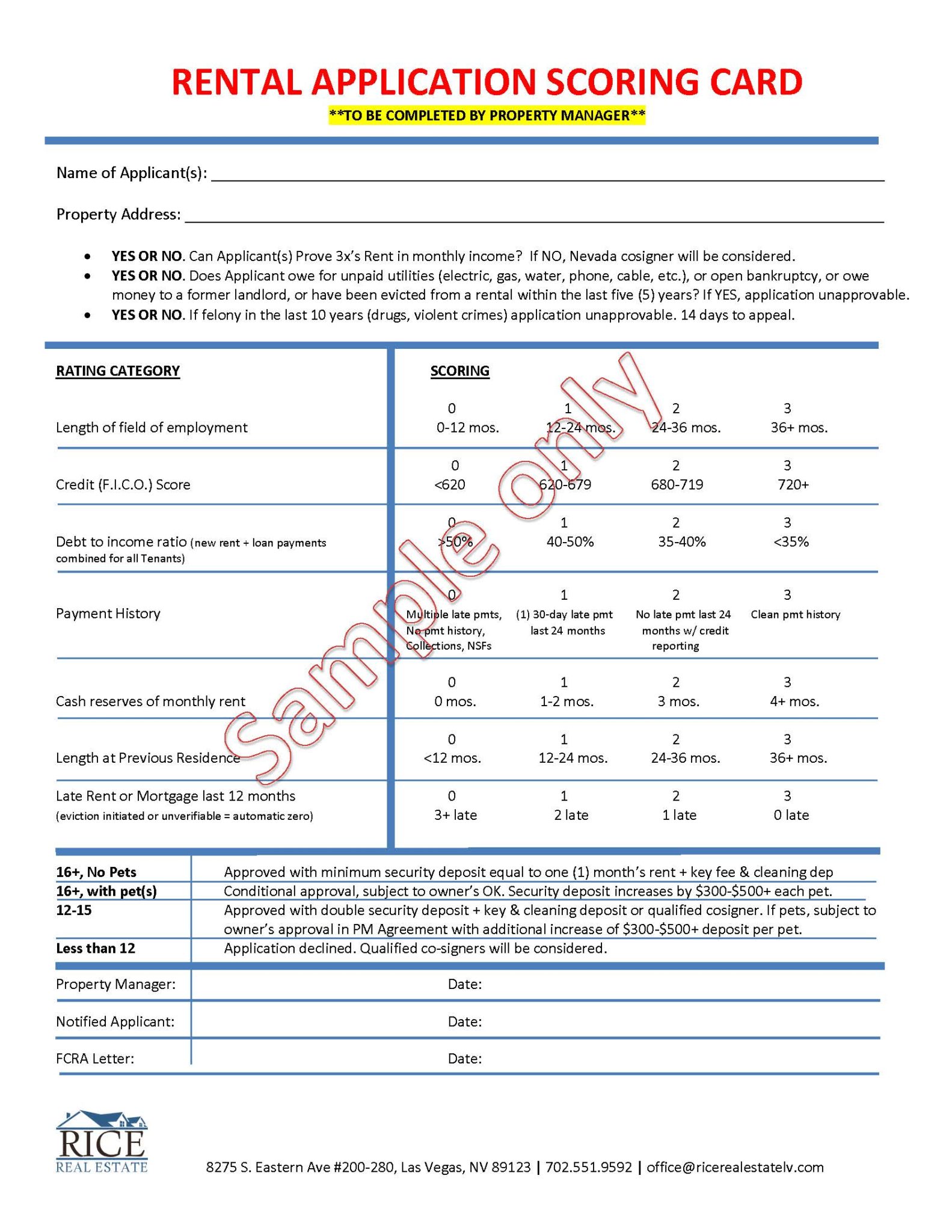
Rice Real Estate & Property Management uses a documented 21-point scoring card to support consistent review of complete applications. The published Rental Criteria establish the qualification standards, while the scoring card organizes the factors being reviewed and may also be used to compare qualified applications when more than one applicant is under consideration.
The scoring card supports the published Rental Criteria and documented application review rather than replacing them. It does not permit applicant decisions based on personal preference or standards applied differently to application files presenting comparable facts. When multiple applicants qualify, it provides a consistent way to compare the complete application files.
The image shown is an illustrative sample of the scoring-card format. Current qualification standards and application requirements are published on the Rental Criteria page.

Occupancy Review
Why Every Adult Occupant Is Screened
Rice Real Estate & Property Management reviews each proposed occupant age 18 or older before approving the household. This helps confirm who is authorized to reside at the property, who will be responsible under the lease, and whether the approval decision reflects the qualifications of the complete proposed household.
The same adult-occupant requirement applies regardless of an adult’s relationship to the primary applicant. Minor children are not screened as adult applicants, and household composition or familial status is not used as a qualification factor. If a resident later requests to add or remove an adult occupant, Rice Real Estate & Property Management requires review and written documentation before approving changes to occupancy or lease responsibility.
Multiple Applications
How Multiple Approved Applications May Be Prioritized
When more than one complete application is under consideration, Rice Real Estate & Property Management first determines which applicants satisfy the published Rental Criteria. The documented 21-point scoring process may then be used to compare approved applications and determine which applicant is offered the property first.
When several applicants qualify, the documented comparison provides a consistent and supportable basis for deciding which approved applicant is offered the property first. Owners are not asked to choose among qualified applicants based on names, photographs, family composition, personal impressions, demographic information, or another protected characteristic.
Why Application Completeness Matters
Multiple applications cannot be compared consistently until the required information and supporting documents are available for review. A complete application may move forward while another remains incomplete, helping prevent an unfinished file from delaying the owner’s leasing decision.
An application is considered complete only when the required information and supporting documents are available for review and comparison.
Applicant identity and screening authorization must be confirmed before third-party screening reports can be included in the application review.
Materially false, misleading, or unverifiable information may disqualify an application from further consideration.
A complete and verified application may move forward without requiring the owner to delay review for an unfinished file.
Pets, Animals, and Owner Risk
Owner Choice Supported by Pet Screening and Added Protection
Rice Real Estate & Property Management generally recommends that owners consider qualified household pets because some of the strongest prospective residents have a dog or cat. Pet-friendly does not mean automatic approval, and the property owner retains the final decision.
The Owner Sets the Household Pet Policy
The owner may approve qualified household pets, establish reasonable written restrictions, or choose an owner-approved no-pet policy. When pets are considered, Rice Real Estate & Property Management applies the property’s approved restrictions together with its written Pet Policy before a pet is approved for move-in.
Pet and Animal Information Is Documented
Each household completes the appropriate pet and animal documentation. For household pets, the review considers available behavior history, including any documented bite history, age, size, vaccination information, care, insurance requirements, and other housing-related risk factors. A documented bite history must be disclosed and reviewed as part of the individual pet approval process. The review may result in approval, approval with additional requirements, or denial.
Added Protection for Pet-Friendly Homes
When an owner allows approved household pets, qualifying managed properties receive Rice Real Estate & Property Management’s Pet Damage Guarantee. The program provides added financial protection when verified damage from an approved pet exceeds the resident’s security deposit, subject to the published guarantee terms.
A request to use an animal because of a disability is not evaluated under the household Pet Policy. Rice Real Estate & Property Management documents and reviews each Reasonable Accommodation Request separately based on the facts of the request and applicable law. Under Rice Real Estate & Property Management’s process, an animal approved as a reasonable accommodation is documented separately and is not charged household pet fees or pet deposits.
Long-Term Outcome
Better Screening Supports Better Lease Outcomes
Tenant screening supports decisions made before approval, but its effects continue throughout the lease. A documented review of financial qualification, rental history, application accuracy, authorized occupancy, and lease responsibility helps Rice Real Estate & Property Management make a better-supported placement decision for the owner and rental property.
Vacancy, turnover, property damage, lease-enforcement problems, and poor communication can reduce a rental property’s financial performance. Tenant screening is an early risk-control step that helps Rice Real Estate & Property Management evaluate applicant qualification, documentation, rental history, and authorized occupancy before approval.

Owner Questions
Tenant Screening Questions Owners Often Ask
These are the screening issues that matter most for Las Vegas Valley rental owners. Broader management questions are answered on the Owner FAQs page.
Do you approve applicants based only on credit score?
No. Creditworthiness is reviewed, but it is only one part of the complete application file. Income, rental history, debt-to-income ratio, reserves, employment history, residency history, background, eviction history, and supporting documents also matter under the published Rental Criteria.
What happens when multiple people apply?
When multiple complete applications qualify, the documented 21-point scoring process may be used to compare the approved applications and determine which applicant is offered the property first.
Why are all adult occupants screened?
Reviewing every proposed adult occupant helps establish the approved household, authorized occupancy, financial qualification, and lease responsibility before a lease is offered.
Does the owner decide whether household pets are allowed?
Yes. The owner makes the final decision about the household pet policy before marketing. When pets are considered, Rice Real Estate & Property Management applies its Pet Policy, pet and animal affidavits, screening, lease documentation, insurance requirements, applicable fees and deposits, and the Pet Damage Guarantee. Disability-related animal requests are reviewed separately through the reasonable accommodation process. Under Rice Real Estate & Property Management’s process, an animal approved as a reasonable accommodation is documented separately and is not charged household pet fees or pet deposits.
What happens after an applicant is approved?
After approval, Rice Real Estate & Property Management completes the lease and verifies the required pre-possession conditions before the resident receives access to the property.
Where can applicants review the exact requirements?
Exact qualification standards, required documents, and application procedures are published on the Rental Criteria page. Pet and animal documentation is explained on the Pet and Animal Affidavit page.
Want a More Careful Tenant Screening Process?
Rice Real Estate & Property Management helps homeowners, accidental landlords, and rental property owners lease long-term rental houses, townhomes, and condos through a documented and consistently applied screening process designed to reduce preventable leasing, occupancy, and documentation risks.